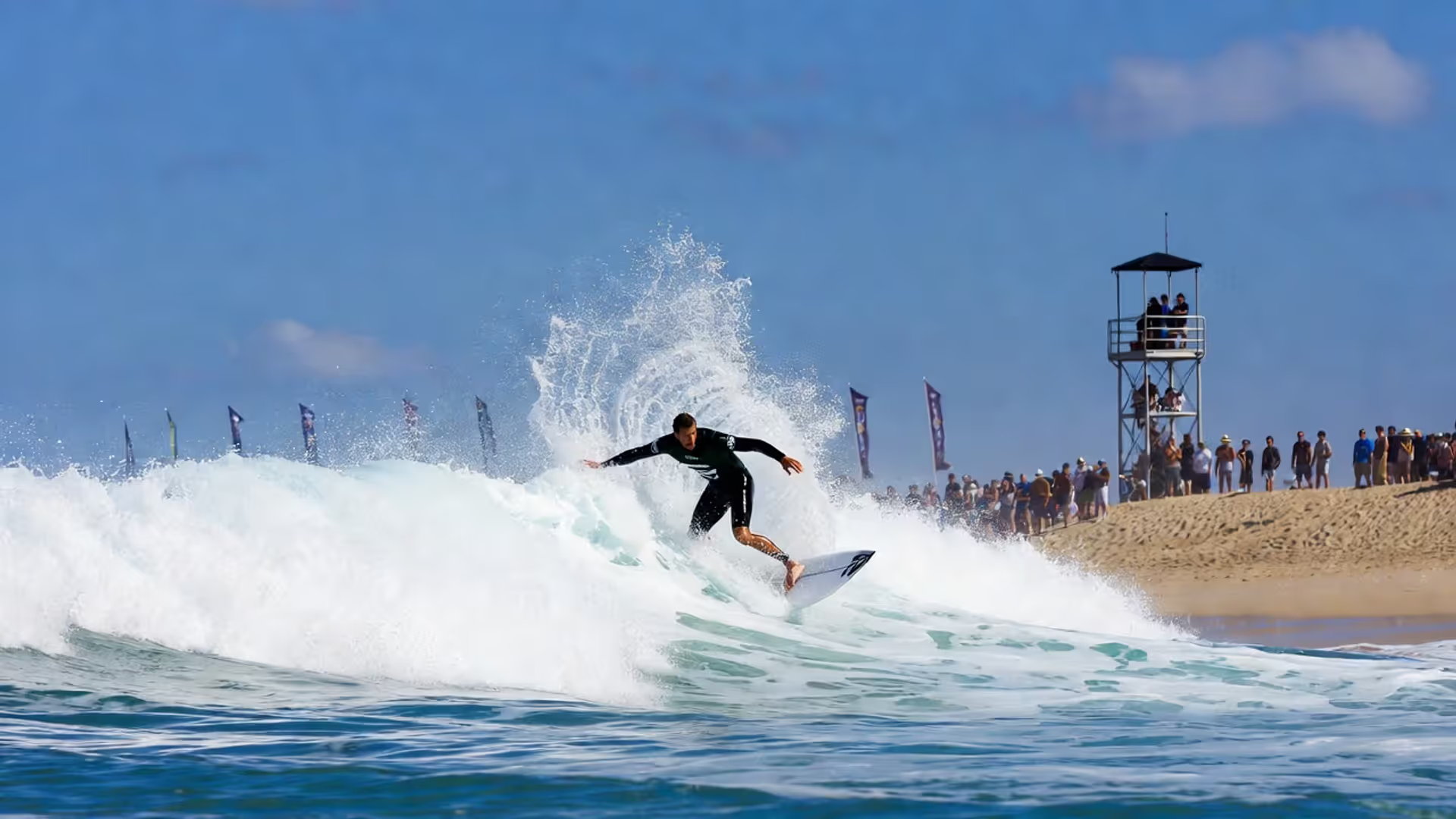
One wave can decide the entire heat
How Surfing Competitions Work: Rules, Scoring, and Heat Formats Explained

Content
Surfing competitions transform the ocean into an arena where athletes battle not just each other, but also the unpredictable nature of waves themselves. Unlike most sports with standardized playing fields, competitive surfers face constantly changing conditions while navigating complex rules about who can catch which wave and when.
The mechanics behind these events—from heat progression to scoring calculations—can seem opaque to spectators and even experienced recreational surfers. Understanding these systems reveals why certain strategic decisions matter, how a single wave can change everything, and what separates championship-level performances from early-round exits.
The Basic Structure of a Surf Competition
Most professional surfing contest structure follows an elimination format where surfers advance through successive rounds until a final winner emerges. The typical bracket starts with Round 1, where the field is largest, then narrows through subsequent rounds (Round 2, Round 3, Quarterfinals, Semifinals, Finals) as competitors are eliminated.
Man-on-man heats—featuring just two surfers—dominate professional events because they create clear head-to-head battles and reduce confusion about priority rules. Some contests use three or four surfers per heat in early rounds when the competitor pool is large, but elite events almost exclusively use two-surfer formats from the quarterfinals onward.
Qualification for heats depends on the event tier. Championship Tour surfers earn their spots through previous season performance and are seeded into the main event. Qualifying Series competitors must often surf through trials—preliminary rounds where dozens of surfers compete for a handful of main-event slots. Local contests typically use open entry with random or seeded heat draws based on past results or ranking.
The bracket structure includes both elimination rounds (where losers exit the event) and advancement rounds (where winners move up). Many professional events now use a hybrid system: early rounds might eliminate surfers entirely, while later rounds employ a "second chance" format where heat losers drop into a repechage bracket for another opportunity to advance.
Wave conditions dictate how many heats can run per day. Contest directors monitor forecasts constantly, sometimes running 12-hour competition days when swells are optimal, or placing events "on hold" for days when surf is poor. This flexibility means competitions scheduled for a week-long window might complete in three days or extend to the final possible day.

Author: Tyson Caldwell;
Source: 2templatedesign.site
Understanding Surf Heat Formats and Time Limits
Standard heat duration ranges from 20 to 35 minutes, with 25-30 minutes most common at professional levels. This timeframe creates urgency—surfers must balance patience for quality waves against the ticking clock. Local contests sometimes run shorter 15-20 minute heats to accommodate large fields within daylight hours.
The surf heat format explained simply: surfers paddle out when the horn sounds, compete for waves during the allotted time, and return to the beach when the final horn blows. Any wave caught before time expires counts, even if the ride finishes after the buzzer. This rule occasionally produces dramatic last-second scores that flip heat results.

Author: Tyson Caldwell;
Source: 2templatedesign.site
Two-Surfer vs. Four-Surfer Heats
Two-surfer heats offer strategic depth. With only one opponent, you can track their wave count and score, adjusting your risk tolerance accordingly. If your competitor posts a strong score early, you know you must take chances on critical waves. The priority system (explained below) works cleanly with two surfers, creating a chess match of positioning and wave selection.
Four-surfer heats increase chaos. More bodies in the lineup mean less clarity about who has priority, more potential for interference calls, and fewer quality waves per person. Strategic planning becomes harder when three opponents are simultaneously hunting waves. However, four-surfer formats expedite early rounds—cutting the number of heats needed to advance 32 surfers from 16 heats down to eight.
Three-surfer heats occasionally appear but are rare, as they create awkward priority rotations and uneven matchups. Most contest directors avoid this format unless necessary for bracket mathematics.
How Many Waves Count Toward Your Score
Surfers can catch as many waves as possible during their heat, but only their best two waves count toward their final score. This rule encourages aggressive surfing—you can take risks on marginal waves without penalty since poor scores simply don't count.
The best-two-waves rule creates interesting scenarios. A surfer might have a solid 7.5 and 7.0 banked (14.5 total) but continues hunting for an excellent 8+ wave to replace the lower score. Meanwhile, an opponent with only one good wave (say, an 8.0) desperately needs a second scoring ride, making them more vulnerable to priority violations from rushed decisions.
Some specialty events use different formats—big wave contests might count only a single best wave, while expression sessions judge overall performance rather than individual waves. But the two-wave format dominates mainstream competitive surfing.
How Priority Rules Control Wave Selection
The surf contest priority rules system determines who has first choice on any wave. The surfer with priority can paddle for any wave without interference. Surfers without priority must yield—if they catch a wave that the priority surfer was also paddling for, they receive an interference penalty.
At the heat start, priority goes to the surfer whose jersey color was announced first (typically indicated by colored rashguards—red, blue, yellow, white). After the first wave is caught, priority rotates to the next surfer. This rotation continues throughout the heat: catch a wave, lose priority; wait patiently, gain priority.
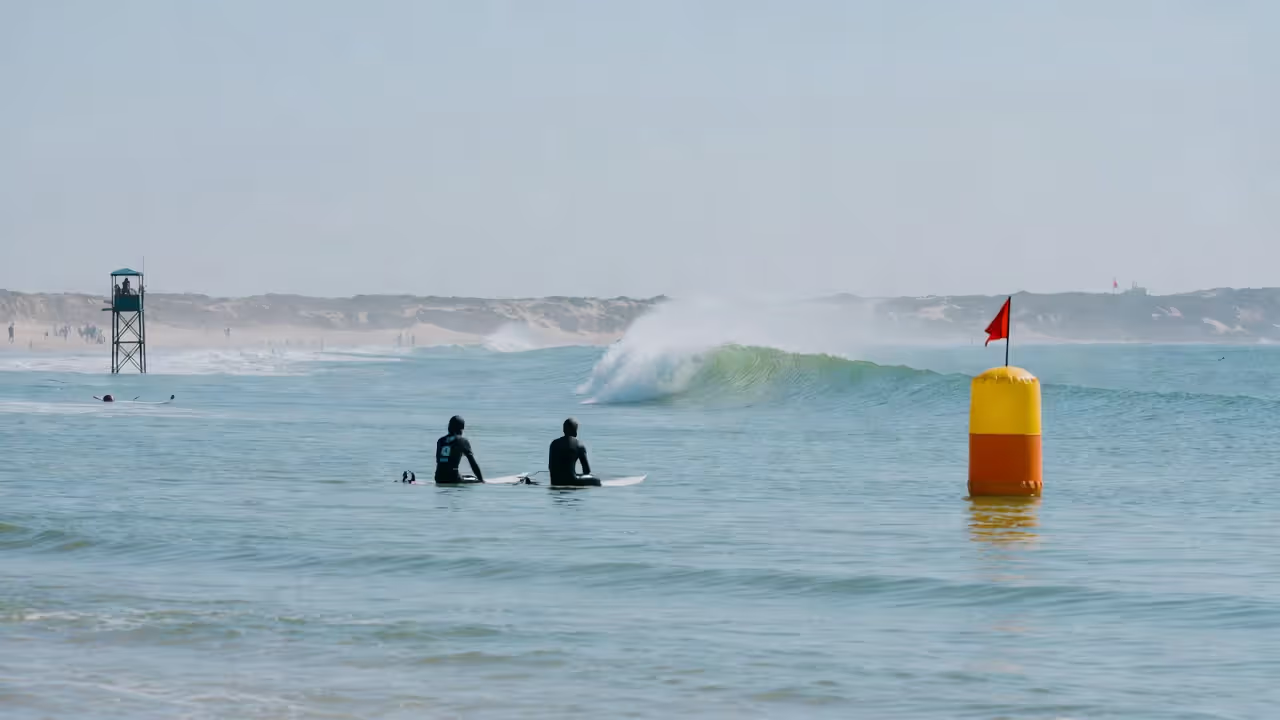
A physical priority buoy floats in the competition zone displaying the current priority holder's color. Surfers glance at this buoy constantly—it's their most important reference point beyond the waves themselves. Beach announcers also call out priority changes, though surfers in the water may not hear these updates over ocean noise.
Strategic implications run deep. Holding priority gives you control, but waves don't arrive on demand. You might hold priority for five minutes while nothing good materializes, watching the clock drain away. Meanwhile, your opponent without priority can freely catch mediocre waves since you're unlikely to paddle for them, slowly building a respectable heat total.
The priority holder faces a dilemma on borderline waves: paddle for a decent-but-not-great wave and lose priority, or wait for something better while time evaporates? Experienced competitors read conditions and make calculated choices. In inconsistent surf, you might take the first reasonable wave. In pumping conditions with frequent sets, patience pays off.
Priority violations occur when a non-priority surfer catches a wave that the priority surfer was positioned for and paddling toward. Judges determine if interference occurred based on whether the priority surfer was genuinely committed to the wave or just sitting nearby. The penalty is severe—typically a deduction of points from the interfering surfer's second-best scoring wave, or in extreme cases, their best wave.
Author: Tyson Caldwell;
Source: 2templatedesign.site
The Surf Competition Scoring System Breakdown
Judges score each wave on a 0-10 scale, with decimal precision (6.5, 7.3, 8.9, etc.). A panel of five judges scores independently, then the highest and lowest scores are dropped and the middle three averaged. This system minimizes bias from any single judge.
The scale breaks down roughly as: 0-1.9 (poor/incomplete), 2.0-3.9 (fair), 4.0-5.9 (average), 6.0-7.9 (good), 8.0-8.9 (excellent), 9.0-10.0 (near-perfect to perfect). Scores above 9.5 are extremely rare, reserved for rides that combine technical difficulty, innovation, and flawless execution in critical conditions.
Your two highest-scoring waves are added together for your heat total. If you score a 7.5 and an 8.0, your total is 15.5 points. Your opponent needs 15.51 or higher to win. This simple math drives every strategic decision—you always know exactly what score you "need" to overtake your competitor.
The surf contest judging explained through scoring criteria reveals what actually earns points. Judges don't score on subjective style preference but rather on defined performance elements.
What Judges Actually Score: The Five Key Criteria
The World Surf League and most professional events use five core judging criteria, weighted equally in determining scores:
Commitment and Degree of Difficulty: How critical was the wave section? Did the surfer take off deep in the pocket on a steep, powerful wave, or cruise onto a mellow shoulder? Bigger risks in heavier conditions earn higher scores. A barrel ride in consequence waves scores higher than the same barrel in soft conditions.
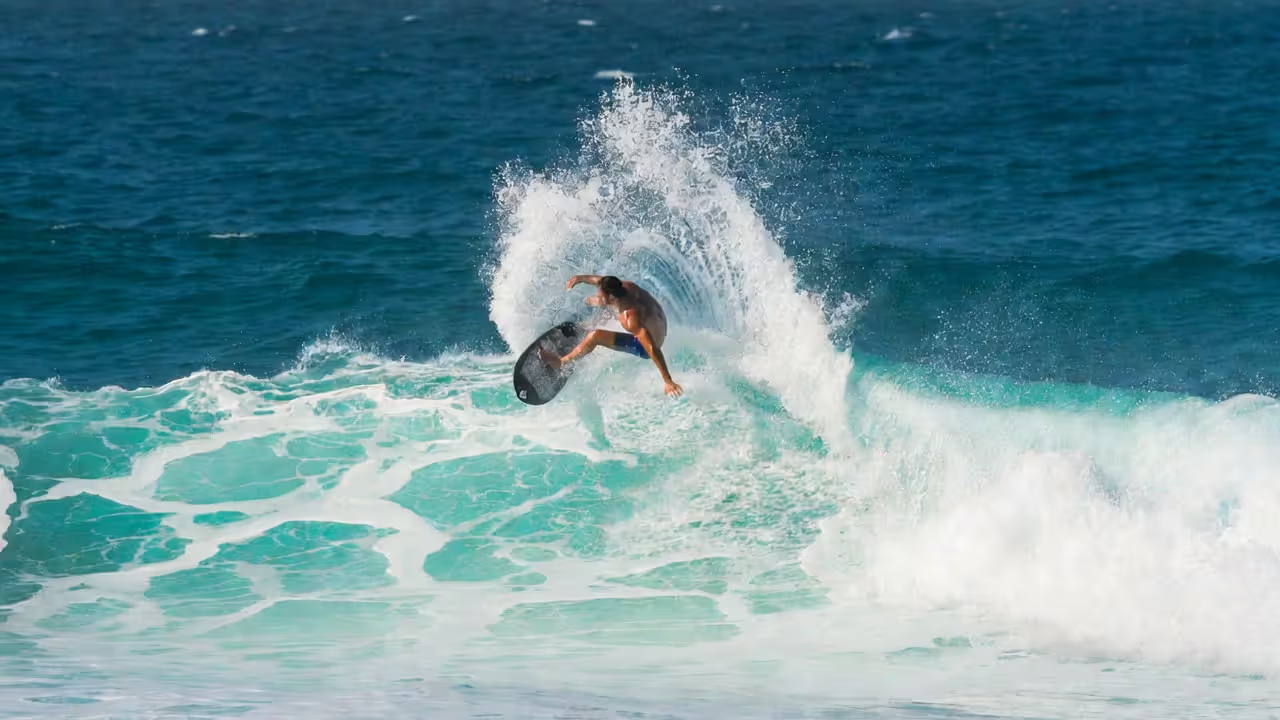
Innovative and Progressive Maneuvers: Did the surfer attempt modern, cutting-edge moves? Aerial rotations, alley-oops, and technical fin-free maneuvers demonstrate progression. Judges reward surfers who push boundaries rather than repeat standard turns, even if execution isn't perfect.
Combination of Major Maneuvers: A wave with multiple significant turns, snaps, or aerials scores better than a single maneuver. A ride with a barrel section followed by two critical snaps on the reform beats a longer wave with only one good turn. Quality over quantity matters—three excellent turns trump six mediocre ones.
Variety of Maneuvers: Mixing different move types shows complete surfing. A wave with a floater, a carving turn, and a finishing air demonstrates more skill than three identical backside snaps. Judges look for surfers who can adapt their approach to different wave sections rather than repeating their favorite move.
Speed, Power, and Flow: The foundation underlying everything. Maintaining speed through sections, generating power from turns, and linking maneuvers with smooth flow separates good rides from great ones. A surfer who bogs down between turns or struggles to generate momentum won't score well even if they attempt difficult moves.
Author: Tyson Caldwell;
Source: 2templatedesign.site
| Judging Criteria | What It Means | Importance | Example |
| Commitment and Degree of Difficulty | Taking off in critical positions on powerful waves | High—sets the baseline score potential | Late takeoff on a hollow 8-foot barrel vs. easy drop on a mushy wave |
| Innovative and Progressive Maneuvers | Modern, boundary-pushing moves | High—separates elite from good surfers | Full rotation aerial, alley-oop, or new fin-free variation |
| Combination of Major Maneuvers | Multiple significant moves per wave | Medium-High—builds score quickly | Barrel to snap to air combo vs. single turn |
| Variety of Maneuvers | Mixing different move types | Medium—demonstrates complete surfing | Carves, snaps, floaters, and aerials on one wave vs. repetitive moves |
| Speed, Power, and Flow | Maintaining drive and linking sections smoothly | Critical—the foundation for everything | Generating speed through flat sections to hit the next lip vs. stalling out |
Judges also consider wave quality relative to available conditions. On a small, weak day, a 7-point ride might feature moves that would only earn a 5 in perfect surf. Conversely, simply making a wave in massive, dangerous conditions can warrant a decent score even without technical maneuvers.
How Interference Penalties Affect Your Score
Interference calls devastate heat results. The standard penalty deducts points from your second-best wave, often reducing it to half value or assigning a fixed low score (like 2.0). If you had an 8.0 and a 7.5 (15.5 total) and receive an interference on your 7.5, it might become a 3.0, dropping your total to 11.0—usually impossible to overcome.
Priority interference is the most common type, occurring when a non-priority surfer catches a wave the priority surfer was pursuing. Judges review video footage and determine if the priority surfer had genuine opportunity to catch the wave. If yes, interference is called. If the priority surfer was too deep or too far away to realistically make the wave, no interference is assessed.
Regular interference (less common in professional events) happens when a surfer hinders another's ride—paddling in front of them, dropping in, or blocking their path along the wave. This blatant violation results in immediate penalties and can even lead to disqualification in extreme cases.
The difference between priority interference and regular interference matters: priority interference requires the priority surfer to be actively pursuing the wave, while regular interference is about physical obstruction during the ride itself. A surfer can commit regular interference even if they had priority, by dropping in on an opponent already riding the wave.
Common Mistakes Surfers Make in Competition Heats
Priority violations from impatience top the list. A surfer without priority sees a decent wave, forgets to check the buoy, and paddles frantically—only to realize mid-takeoff that they're interfering. That moment of lost discipline can cost the entire heat.
Poor wave selection plagues intermediate competitors. They burn energy on marginal waves that can't possibly generate good scores, leaving themselves exhausted when a quality set finally arrives. Experienced surfers let mediocre waves pass, conserving energy and maintaining position for the waves that matter.
The risk-versus-safety calculation trips up many surfers. Playing it too safe—sticking with standard turns instead of attempting progressive moves—caps your scoring potential. But taking wild risks on every wave leads to falls and incomplete rides. The best competitors calibrate risk based on their current heat position: if you're losing with five minutes left, you must gamble; if you're ahead with two minutes remaining, a safe completed ride might secure victory.
Clock management errors create heartbreak. Surfers misjudge remaining time and find themselves stuck on the beach or paddling back out when the final horn sounds, unable to improve their score. Conversely, some surfers panic about time and force waves too early, catching a poor wave with ten minutes still remaining. Checking the beach clock or listening for time calls from coaches prevents these mistakes.
Not understanding judging criteria for specific conditions causes confusion. Some surfers attempt huge aerials in small, weak waves where judges prioritize flow and combination surfing. Others try to muscle through maneuvers in heavy, critical surf where commitment and tube-riding earn maximum points. Reading what conditions reward—and adjusting your approach accordingly—separates strategic competitors from one-dimensional surfers.
How Professional Events Differ from Local Contests
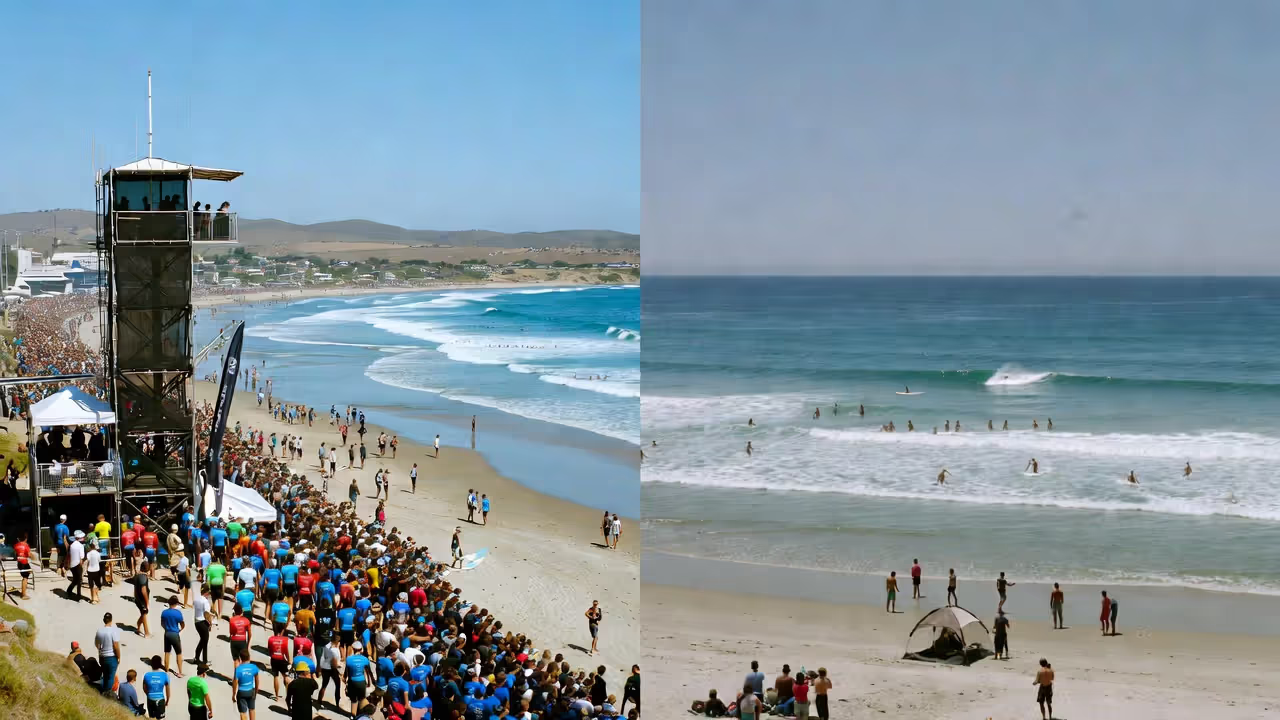
The WSL Championship Tour represents surfing's pinnacle, featuring the world's top 34 men and 18 women competing at premier breaks worldwide. These events use exclusively two-surfer heats from Round 1 onward, employ five-judge panels with video review capability, and offer massive prize purses. Contest directors have access to extended holding periods (sometimes weeks) to wait for optimal conditions.
Qualifying Series events sit one tier below, functioning as the pathway to the Championship Tour. QS contests range from regional 1,000-point events to international 10,000-point competitions. Larger QS events mirror CT structure with professional judging panels and video review, while smaller regional QS contests might use three judges and simpler formats.
Local contests operate with minimal infrastructure. Judging panels might consist of three respected community surfers rather than certified officials. Video review is rare—judges make calls in real-time from the beach, occasionally missing critical moments. Heat duration might be shorter (15-20 minutes) to accommodate large fields, and four-surfer heats are common in early rounds.
Prize money illustrates the gap: Championship Tour events offer hundreds of thousands of dollars, major QS contests provide $25,000-$100,000 in total prize money, and local events might award $500 to the winner or simply trophies and sponsor products.
Format complexity increases at higher levels. Local contests typically run straightforward single-elimination brackets. Regional events might add a repechage round. Championship Tour events use sophisticated formats with multiple elimination rounds, seeding advantages for top performers, and complex advancement scenarios that require spreadsheets to track.
Author: Tyson Caldwell;
Source: 2templatedesign.site
Technology plays a major role professionally. WSL events feature live scoring displays visible to surfers in the water (via beach-mounted screens), instant replays for judges, and sophisticated timing systems. Local contests rely on air horns, manual scorecards, and announcements through megaphones.
The judging itself differs in consistency and expertise. WSL judges undergo extensive training, maintain certification, and judge dozens of events annually—they develop calibrated standards and understand nuanced scoring. Local judges might be talented surfers but lack formal training, leading to more subjective and variable scoring.
As 11-time World Champion Kelly Slater once explained: "In competition, you're not just surfing against your opponent—you're surfing for five judges who need to see everything you do. The best wave of your life doesn't matter if you ride it away from the judging zone or if they miss your best turn. Competition surfing is a completely different skill than free surfing."
Frequently Asked Questions About Surf Contests
Understanding Competition Surfing Opens New Appreciation
The mechanics behind surfing competitions—from priority rotations to scoring calculations—reveal a sport far more strategic than it appears from the beach. Every decision carries weight: which waves to paddle for, when to take risks, how to manage time against an opponent's score.
These systems exist to create fair competition in an inherently unpredictable environment. Waves don't arrive on schedule, conditions change mid-heat, and ocean chaos must somehow be structured into brackets and point totals. The rules aren't perfect—debates continue about scoring subjectivity and format fairness—but they've evolved over decades to reward progressive, committed surfing while minimizing chaos.
For spectators, understanding heat formats and scoring transforms watching competitions from confusing to compelling. You'll recognize why a surfer lets a wave pass (wrong priority), appreciate the calculated risk in a last-minute aerial attempt (needing a specific score), and feel the tension when time expires with a surfer paddling frantically for one final opportunity.
For competitors, mastering these systems is as crucial as mastering surfing itself. Technical ability means nothing if you can't navigate priority rules, select optimal waves, or calibrate risk appropriately. The ocean provides the stage, but competition structure determines who wins.
Whether you're watching the Championship Tour finals or entering your first local contest, these fundamentals remain constant: catch your best two waves, respect priority, understand what judges reward, and manage the clock. Everything else is execution.